The Genetics you need to grow mushrooms
P. Ovoideocystidiata is a psilocybin mushroom in the section Stuntzae, having psilocybin and/or psilocin as main active compounds. It is closely related to P. subaeruginascens from Java, P. septentrionalis from Japan, and P. wayanadensis from India. This mushroom was first documented by Richard V. Gaines in Montgomery County, Pennsylvania in June 2003. Although it is sometimes confused with Psilocybe caerulipes, it can be distinguished by its rhomboid spores, larger stature, earlier fruiting season and membranous annulus.
FORMAT INFORMATION
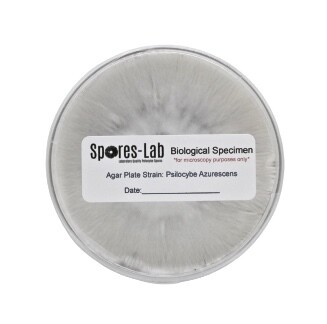
Agar Culture Option Includes: 1x P. Ovoideocystidiata Isolate Agar culture in a 100x15mm Parafilm-wrapped Petri Dish.
AGAR CULTURES ARE MOST VIGOROUS IF USED WITHIN 2-3 MONTHS OF RECEIPT.
FRESHLY PREPARED FOR EVERY ORDER.
Our agar plates are not kept as pre-made inventory. Instead, each plate is prepared specifically for your order to maximize freshness, culture health, and viability.
While your selected variety may occasionally be available and ready to ship immediately, most agar plates are MADE TO ORDER. Please allow approximately 3 weeks for production before shipping.
Each plate is prepared under sterile laboratory conditions and carefully inspected prior to shipment.
SPECIES INFORMATION
Habitat: Eastern United States from Kentucky to Rhode Island and as far south as Mississippi. Recently reported in Western United States from as far North as Washington to as far south as Souther California. Commonly found along rivers and streams, often in man made areas of mulch and wood chips and is often found alongside Japanese Knotweed.
Climate: Temperate/Oceanic
Strain Origin: First documented by Richard V. Gaines in Montgomery County, Pennsylvania.
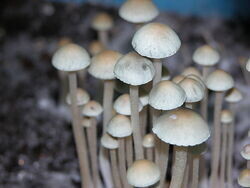
Cap: 10-80 mm in diameter, convex to subumbonate, chestnut to orangish brown to pearly cream color. During youth, the cap is usually highly convex and dark brown/black (the stem is white). During maturity, the entire mushroom becomes light-brown (cinnamon-brown when moist and light-beige when dry). Mature specimens often naturally exhibit blue-greenish bruising, and old, dried-out specimens are usually all black. Appearance may vary significantly among individuals, depending on maturity and location. Flesh thick, pliant. Bruises blue and green where injured.
Stem: 15–130 mm in length and 2–20 mm thick, with a sometimes hollow stem that is smooth at the top and and often having small hairs near the bottom. Color is whitish with irregular yellowish, brownish, or bluish tones.
Spores: Rhomboid to subrhomboid in face view, subellipsoid in side view, thick-walled, with the wall 0.8 to 1.5 µm thick.