


Trichoderma on Psilocybe Cubensis: Why Green Mould Happens and How to Stop It

Updated: Jun 16
The green invader that kills grows before they start — and the sterile technique secrets that keep it out for good.

This article is part of the Spores Lab Contamination & Sterile Technique pillar. For the complete guide to contamination biology and prevention, start at sporeslab.io/post/sterile-technique-preventing-contamination-in-mushroom-cultivation
You check your grow bag after five days of colonization. The mycelium is spreading, white and healthy — and then you see it. A patch of green, bright and fuzzy, creeping in from the corner. Your stomach drops. You already know what it is. Trichoderma on Psilocybe Cubensis.
It's the most common and most demoralizing contaminant in mushroom cultivation. It attacks grain spawn, colonized bulk substrates, and fully fruited blocks. It can wipe out an entire batch in 48 hours. And unlike some moulds, Trichoderma doesn't politely retreat — it competes aggressively with your mycelium for resources and produces compounds that actively suppress fungal growth.
The good news? Trichoderma is also one of the most preventable contaminants in the game. Once you understand where it comes from and how it gets in, you can shut the door on it — and keep it shut. This guide is going to walk you through everything: what Trichoderma is, why it appears, how to identify it early, and the sterile technique practices that stop it before it starts.
What Is Trichoderma on Psilocybe Cubensis?
Trichoderma is a genus of fast-growing, green-sporing fungi found virtually everywhere in soil, decaying wood, and organic matter. It's not a single species — there are over 200 known Trichoderma species — but the ones that plague mushroom growers are typically T. harzianum, T. viride, and T. aggressivum. The last one, as its name suggests, is particularly ruthless.
In nature, Trichoderma plays an important ecological role — it's a decomposer and natural antagonist of other fungi. It's actually used commercially as a biocontrol agent in agriculture to suppress plant pathogens. But in your grow tent or lab, its aggressive mycelium growth and ability to outcompete cultivated species makes it a nightmare.
Trichoderma spores are microscopic, lightweight, and omnipresent. They drift through air currents, cling to surfaces, hide in unsterilized substrate, and hitch rides on contaminated tools or hands. When conditions are right — warmth, moisture, and organic material — they germinate fast. Faster, often, than your mushroom mycelium.
How to Identify Trichoderma
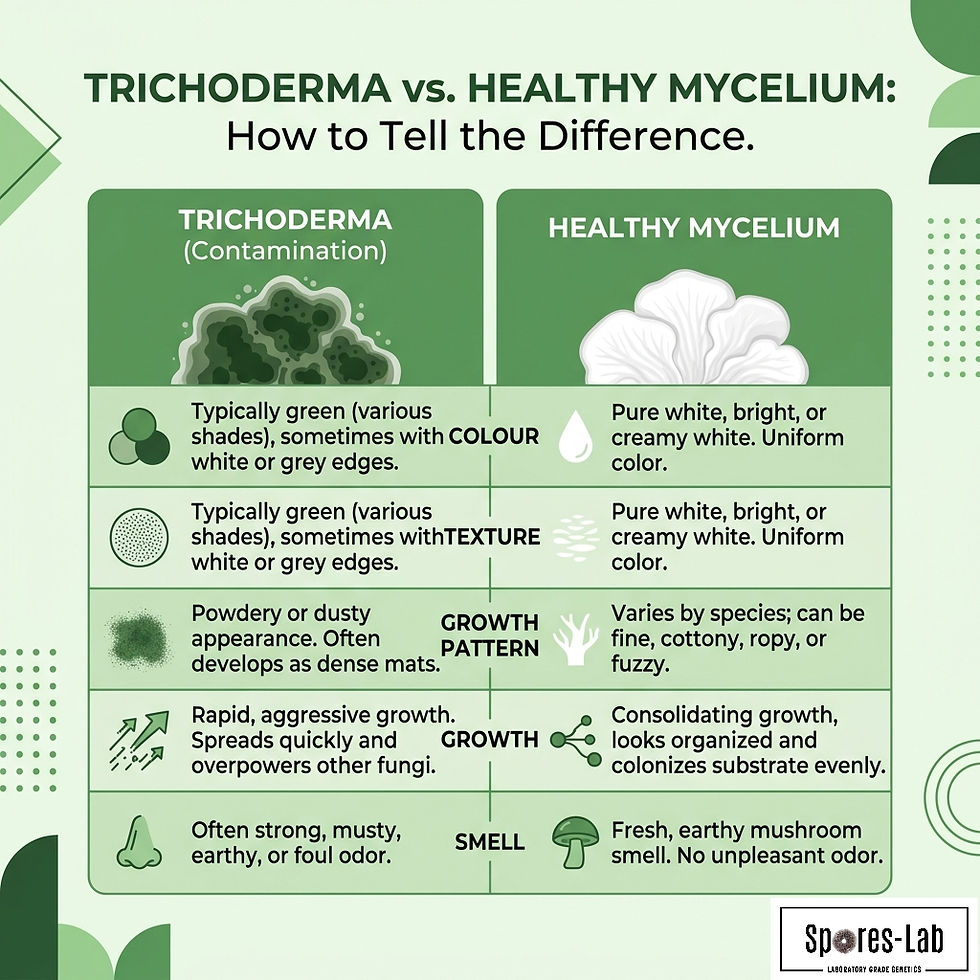
The signature is unmistakable once you've seen it: a bright to dark green powdery or fluffy growth, often with a white margin where it's still actively spreading. It typically appears in spots or patches before expanding to cover large areas. You may also notice a musty, earthy smell — though by the time you're smelling it, the contamination is already severe.
Early identification is critical. In the first 24–48 hours, Trichoderma can appear white and be mistaken for mycelium. The telltale difference: mushroom mycelium growth is stringy, rope-like, and rhizomorphic. Early Trichoderma is fluffier and more cottony, and within a day or two, it will begin to show green tones — especially at the centre of the patch where sporulation is occurring.
Quick ID checklist:
• Colour: White early → yellow-green → bright green → dark green as it matures
• Texture: Fluffy/powdery, not ropy or stringy like mushroom mycelium
• Pattern: Spots or patches, often near injection points or grain surfaces
• Smell: Musty, earthy, or coconut-like in some species
• Speed: Doubles in size quickly — if it's growing fast, suspect contamination
Why Trichoderma Appears: The Real Causes
Most growers blame bad luck. The reality is that Trichoderma contamination almost always has a traceable cause. Understanding those causes is the foundation of preventing it.
1. Inadequate Sterilization of Substrate
This is the number one cause. Grain spawn and bulk substrates like hardwood or straw contain organic compounds that Trichoderma loves. If your sterilization process doesn't reach adequate temperature for long enough, viable Trichoderma spores survive. High-moisture grain is particularly risky — overly wet grains create pockets that heat penetrates poorly.
Industry standard for grain sterilization is 15 PSI (121°C / 250°F) for 2.5 to 3 hours for standard grain bags. Under-pressuring or cutting short the sterilization time is the most common reason growers find themselves dealing with Trichoderma outbreaks batch after batch.
2. Contaminated Inoculant
If your spore syringe, liquid culture, or agar culture is already carrying Trichoderma — or was prepared in a contaminated environment — you're injecting the problem directly into your substrate. This is why sourcing from reputable suppliers matters enormously. At Spores Lab, genetic stability and culture health are tested before any products ship, because a clean inoculant is your first and most important line of defence.
3. Contaminated Work Environment
Still air boxes, flow hoods, and work surfaces all need to be clean. Trichoderma spores settle on surfaces and linger. If you're working in a high-traffic area, near an open window, or in a room with poor air circulation control, you're inviting contamination. Even a brief lapse — sneezing near an open bag, or lifting the lid of your still air box — is enough.

4. Poor Injection or Inoculation Technique
Flame-sterilizing your needle, wiping the injection port with isopropyl alcohol, and working quickly all matter. Each second your substrate is open to air is an opportunity for Trichoderma spores to enter. Sloppy sterile technique is especially risky for beginners, and is the reason that even growers using well-sterilized substrate can experience contamination.
5. Damaged Bags or Colonization at Too-High Temperatures
Punctures, pinholes, and faulty filter patches in grow bags create entry points. Heat stress during colonization — substrate temperatures consistently above 28°C — can also weaken mycelium, reducing its competitive advantage over contaminants. Mushroom environment control isn't just about fruiting — it matters during colonization too.
The Role of Competitive Exclusion
Here's something interesting: mushroom mycelium is actually a capable competitor under the right conditions. Vigorous, fast-colonizing cultures can physically crowd out Trichoderma — it's one reason why mushroom genetics and strain selection matter so much. A sluggish, poorly-adapted culture gives Trichoderma time and space to establish itself. A strong, fast-colonizing culture can outpace it.
This is one of the principles behind agar culture work and isolation: selecting for vigorous, sector-free growth on agar lets you identify cultures that will colonize aggressively and competitively — leaving less room for contaminants. Sites like Inoculate the World and North Spore have both discussed this, and it aligns with what we see in practice at Spores Lab.
How to Prevent Trichoderma: Your Complete Protocol
Prevention is the only real strategy. Once Trichoderma is established in a block or bag, the contamination is almost always a write-off. Here's the complete prevention protocol.
Substrate Sterilization
• Grain spawn: 15 PSI for 2.5–3 hours minimum. Ensure grains are properly hydrated (not too wet — field capacity)
• Hardwood/masters mix: 15 PSI for 3–4 hours for larger bags
• Straw (pasteurization): 70–80°C for 1–1.5 hours — full sterilization is overkill for straw and can cause issues, but proper pasteurization is essential
• Cool before inoculating: Never inoculate hot substrate. Wait until bags are fully cooled to room temperature — rushing this step is a common contamination cause
Sterile Technique
• Still air box: Wipe interior with 70% isopropyl alcohol and let sit for 5 minutes before working
• Hands and gloves: Nitrile gloves, spray with 70% IPA, let dry before touching anything
• Needle sterilization: Flame to red hot between inoculations, let cool briefly, wipe with IPA
• Work speed: Be deliberate but fast — minimize time bags or jars are open
• Avoid breathing near open containers: Turn your head away or use a mask
Environmental Controls
• Keep colonization space clean — wipe surfaces regularly with IPA
• Avoid working during high-traffic periods or after activity that stirs up dust and spores
• Maintain colonization temperatures in the 22–26°C range — avoid heat spikes
• Inspect bags daily in early colonization — catching contamination at day 2 is far better than discovering it at day 10
Inoculant Quality
This one is simple: source clean. Whether you're using spore syringes, liquid culture, or agar culture, the quality of your inoculant is foundational. A contaminated syringe means contaminated substrate, no matter how perfect your sterile technique. Work with suppliers who prioritize spore viability and genetic stability — your yield and contamination rate will reflect it.
What To Do When You Find Trichoderma
Despite your best efforts, it can still happen. Here's how to handle it.
• Isolate immediately: Remove the contaminated bag or jar from your colonization space. Do not open it inside your grow area — take it outside or into a sealed bag before disposal
• Do not compost: Trichoderma spores spread readily. Seal contaminated substrate in a garbage bag and dispose of it — don't put it near your grow space, garden, or compost
• Audit your process: A single contaminated bag can be bad luck. Two or more in the same batch usually indicates a process failure — sterilization time, inoculant quality, or sterile technique
• Clean your colonization space: Wipe all surfaces with IPA. If you're running a still air box, consider letting it sit overnight with a lit candle (to consume oxygen and settle air) before your next session
• Check your pressure cooker: Ensure your gauge is accurate and seals are intact. Faulty gauges are a surprisingly common cause of systematic sterilization failures
Trichoderma and Specific Mushroom Species
Some species are more susceptible to Trichoderma than others, and it's worth understanding the spectrum.
Oyster mushrooms (Pleurotus spp.): Fast colonizers that are reasonably competitive. Trichoderma can still win if substrate prep isn't solid, but oysters are generally more forgiving.
Lion's Mane (Hericium erinaceus): Slow colonizer, more sensitive. Lion's Mane grows thrive on well-sterilized hardwood but are more vulnerable to contamination due to slower growth rate. Extra care with sterile technique is essential.
Shiitake (Lentinula edodes): Moderate colonizer, generally robust. Trichoderma outbreaks on shiitake are common when substrate is inadequately sterilized or when contaminated supplemented blocks are used.
Psilocybe cubensis: Popular among research cultivators for its relative ease, but susceptible to Trichoderma especially in bulk substrate pours where sterile technique lapses.
Advanced Strategies: Agar Work and Culture Isolation
For growers looking to move beyond contamination firefighting and into proper mycology science, agar culture work is the next step. Agar plates allow you to:
• Identify and isolate contamination-free sectors from a culture
• Select for vigorous, fast-colonizing mycelium growth with strong competitive characteristics
• Maintain genetic stability across multiple generations of culture
• Detect Trichoderma or other contaminants before they reach grain or bulk substrate
The principle is straightforward: if you can catch and isolate a clean culture at the agar stage, you're preventing downstream contamination across dozens or hundreds of bags. It's one of the best investments a serious grower can make in their practice.

Trichoderma and the Canadian Grower
If you're growing in Canada, there are some additional environmental factors worth noting. Canadian winters mean heated indoor spaces with lower humidity, which can actually help reduce airborne spore loads in your grow area — but it can also create challenges for maintaining proper fruiting humidity for your mushrooms.
Spring and fall tend to be higher-risk seasons for Trichoderma due to increased outdoor spore activity and the tendency for windows and doors to be left open. Canadian mycology enthusiasts operating home labs during these seasons should be especially vigilant about air sealing their work areas.
Spores Lab ships premium, viability-tested cultures across Canada — from BC to Ontario and beyond. Our products are designed for Canadian conditions and Canadian growers. Whether you're a home cultivator working with a simple still air box or a more advanced grower running a laminar flow hood, the fundamentals are the same: clean inoculant, proper sterilization, and disciplined sterile technique.
Quick Reference: Trichoderma Prevention at a Glance
Substrate sterilization
• 15 PSI / 121°C for 2.5–3 hours minimum (grain spawn)
• Correct hydration level before sterilizing
• Cool fully before inoculating
Sterile technique
• 70% IPA on all surfaces and gloves
• Flame-sterilize needles between uses
• Work quickly but deliberately
Environment
• Colonization temp 22–26°C
• Daily inspection of bags in first week
• Clean surfaces before each session
Inoculant quality
• Source from verified, reputable suppliers
• Check liquid culture for cloudiness or green tones before use
• Use fresh syringes — older syringes have higher contamination risk
Explore the Full Growing System
Trichoderma doesn't exist in isolation — it exploits every weak point in your growing system. To build a truly contamination-resistant practice, it helps to understand all the moving parts. On Sporeslab.io you'll find in-depth guides across all six core pillars: Mushroom Growing Basics gives you the foundational knowledge every cultivator needs; Substrate Preparation covers how to sterilize and condition your growing medium for maximum success; Contamination & Sterile Technique (you're reading it) goes deep on prevention and clean lab practice; Growing Environment explains how to dial in temperature, humidity, and airflow for strong colonization and fruiting; Mushroom Genetics & Strains helps you choose and maintain high-performance, competitive cultures; and Growing Equipment walks you through every tool you need, from beginner setups to advanced lab gear. Each guide is designed to work together — strong substrate prep supports sterile technique, good genetics support contamination resistance, and the right environment supports everything. Explore them all at sporeslab.io/blog.
FAQ: Trichoderma and Mushroom Contamination
Q: Can I save a bag that has Trichoderma in it?
Almost never. Once Trichoderma is visible, it has already spread far beyond what you can see. The spore load in the bag is enormous, and attempting to cut out the green section and continue usually just delays the inevitable — and risks spreading spores to your other grows. Dispose of it, audit your process, and start fresh.
Q: My mycelium looks white and healthy — is it definitely safe?
Not necessarily. Trichoderma starts white and can be indistinguishable from healthy mycelium growth in the first 24–48 hours. Watch for unusual fluffiness, unusually fast growth in spots, or any yellowing. Daily inspection during early colonization is essential for catching it before the green appears.
Q: I'm getting Trichoderma every batch. What's the most likely cause?
Systematic batch-wide contamination is almost always a sterilization or inoculant issue. Check your pressure cooker gauge for accuracy (cheap gauges drift and under-report), ensure your sterilization time is adequate for your bag size, and inspect your liquid culture or spore syringes before use. If the contamination appears near the injection site, suspect the inoculant. If it appears randomly throughout the bag, suspect sterilization failure.
Q: Does pasteurization prevent Trichoderma?
Pasteurization reduces — but doesn't eliminate — Trichoderma. For straw substrates, proper pasteurization (70–80°C, 1–1.5 hours) is usually adequate for oyster mushrooms because they colonize so aggressively. For slower-colonizing species or supplemented substrates, full sterilization is strongly recommended. Pasteurization is always a compromise — effective enough for some grows, insufficient for others.
Q: Is there any Trichoderma-resistant mushroom strain?
No strain is fully resistant, but some are significantly more competitive than others. Fast-colonizing oyster varieties and selected high-vigour cultures tend to outcompete Trichoderma more effectively than slow strains. This is one of the strongest arguments for agar isolation — selecting for vigour and competitive growth characteristics. Spores Lab offers cultures specifically maintained for genetic stability and strong colonization performance, which gives you a real competitive edge.
Q: Where can I learn more about sterile technique for Canadian growers?
Start with the Contamination & Sterile Technique pillar guide on sporeslab.io. You'll also find detailed substrate guides, equipment recommendations, and growing environment breakdowns in the blog. For hands-on support, the Spores Lab consulting page connects you directly with expert advice.
Ready to grow clean? Visit Spores Lab.
Shop premium, viability-tested cultures at sporeslab.io/shop — or explore the full blog library for more guides on mushroom cultivation, sterile technique, and mushroom genetics. Questions? Leave a review or sign up for the weekly newsletter for the latest from Canada's mycology community.


Comments